
We have, presently, life possibilities which the most utopic of our ancestors could only dream of. That past idea of a fully developed civilization, in which autonomous machines would carry out all the necessary work, while people would just leisurely spend their days or, when and how they prefered, dedicated themselves to personal development, social participation, arts or sciences, is already achievable in most part, and will completely be a possibility in less than a human generation.
Helping humans more and more, along past centuries, machines brought us to where we are now. Tractors on the fields, large equipments in factories, small office gadgets, home appliances: we have been counting on machines for almost everything we do. But these machines have been growing more and more sophisticated and, recently, that evolution brought us equipment that, more than helping us, are able to entirely replace human labor. For now, that is happening in supermarkets, banks or highway tolls, in repetitive industrial chores and other routine tasks. However, these new autonomous devices convey just a pale sight of what will follow in terms of machine evolution. What follows is artificial intelligence, and is happening right now.
Artificial intelligence is the qualitative step forward which closes a long period of technical progress, having rolled out just by incremental steps. Thanks to it, we now start having the first machines able to replace humans, with benefits, in non-routine tasks as accountants, journalists, lawers, truck drivers, doctors, IT developers, teachers and almost any other. This will change quickly, and deeply, the way we live but, in which way will that be? Will we live out the utopia of a world free of work for survival, of material satisfaction and freedom of occupation for all people? Maybe yes, maybe not. “Idleness is the mother of all vices; work, the father of all virtues.” This idea, born from the european Middle Age religious philsophy, has spread in the world, and even today prevails almost everywhere. “Worth comes from sweat and pain, from the sacrifice brough from work, useful or not, as long as strenuous.” The culture of merit through sacrifice is a factor of great uncertainty in the future we are unraveling. It will not stop the artificial intelligence development, but can stop us from gathering its benefits. Inevitably, machines taking over activities that where exclusively human in the past forces us to choose between live or deny the utopia, between grasp the freedom of (un)occupation for all or continue to force pain and sweat on those that need to secure food and shelter.
The first choice – live the utopia – pushes us to an inner transformation, without which we won’t be able to choose freedom and idleness, especially the freedom and idleness of others. That will be a difficult process, as changes usually are.
On the other hand, effectively, the alternative implies that those who do not have fortunes nor a job will be dependent upon condicional grants, based on “worth” tests, which imply designated professional qualifications courses, even if pointless; remaining available for all jobs, even if inexistent; showing up for all beaurocratic social service checks, even if indignified; behaving according to what officials deem appropriate, even if humiliating.
Surely this, on itself, is not new: conditions to access subsidies in “employment support” and “social integration” programs have always been like this. The novelty lies within the context and the scale: as more and more professions get computerized, more and more people will have to submit to such conditions, in order to survive. The burden of this cost will be ever greater, and will be suported by the taxes of ever less taxpayers: the last people considered productive in the economy. Inequality will grow to extremes, between a subsidized majority and this privileged minority, and still all will remain equally unsatisfied; the former will feel as discarted citizens, and the latter confiscated taxpayers. Social tension will run heavy, the economy sick and public finances unbearable. This society will achieve abundance, yes, but for very few, and will not deliver true freedom to anyone. The general social environment will be inhuman and always on the verge of catastrophe, technology being used in containing social upheaval and, simultaneously, while suffering all the rising consequences of climate change. Plus: within this streched environment, necessarily the worst features of our current social and economic system – competition, individualism and materialism – will also hit historical highs.
However, the key to building a functional, harmonious and humane society has always been, and now more than ever, in the midst of climate change and artificial intelligence, grounded on opposite values: cooperation, solidarity and sharing.
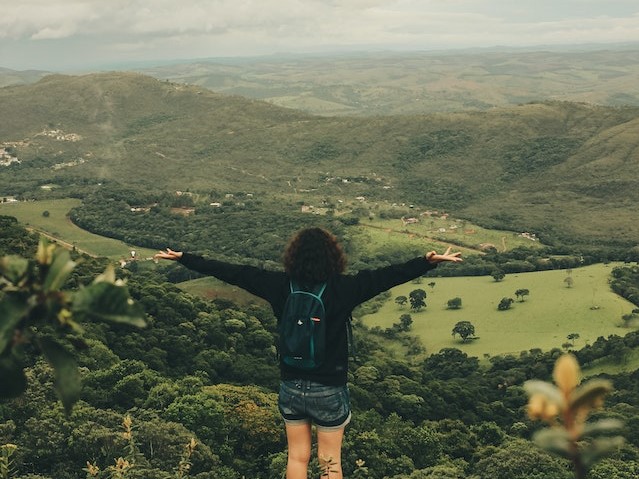
The path of human history has brought us to this point, in the middle of a slope. Now, this path splits in two. One, rough and challenging, carves through virgin rock, all the way through to the top. This path is the one which can lead us to fresh air, open views and large luminous spaces. The other, much more familiar, might look, for now, softer. Its slow descent, however, takes us to a deep valley, drawn in shadow, claustrophobic views and bearing a saturated mist. We have to choose one because history will not stop. Going up is more demanding – to change is difficult. To go down we merely use our own inertia – keeping habits and applying old recipes over new problems. But the rewards of going up or down are also very different. Will we be bold and take on the challenge of going up, into the unknown? Or, on the other hand, will we succumb to this comfort of going down a familiar road? The choice is collective, includes everyone and now is the time to make it.
Translated to English by André Coelho.