


With UBI-AA, money is a means to greater ends: dignity and freedom for all. Global financial balance, for all its transfers, will be null – financial benefits for some will be what others lose – but dignity and freedom balances will not be null. For those who have lost their dignity, due to harsh living conditions, it is restored; and to all is given more freedom. Over these realms, everyone wins and no one loses. Only at the financial level, which is instrumental, the benefits of some must come from other’s losses.
This being clear, it’s important to know what changes, for each participant, occur in strictly financial terms. What does it mean for a rich person? And for a poor person? What changes for those somewhere in the middle? Any willing participant in such scheme is entitled to know all this.
However, UBI-AA financial effects at the individual level, for each participant, will always be different for different implementation scenarios. These will vary as a function of five specific factors, in each community over each moment, as well as, naturally, each participant’s other sources of income.
The first of those factors relates to the contribution rate on participant’s income, used to build a common fund. Number two is how many are of these participants, the actual population bound in UBI-AA. Third, we have the global monthly available income within the community. The fourth factor consists on the individual monthly income of each participant, relative to which the financial effect is being calculated. Fifth, and last, there is the official income tax (in Portugal, the IRS) which would apply to each income, if it were not participating in the UBI-AA.
Let’s write each one of these factors in the following way:
1st – Common fund contribution tax: Txc
2nd – Community population: C
3rd – Community global monthly income: Rg
4th – Individual monthly income: Ri 5th – Individual income tax: Txirs
5th – Individual income tax: Txirs
The monthly value each participant will be requested to contribute in this community process will always be the agreed common fund contribution tax times the individual monthly income: Txc x Ri.
The value each participant will receive from the UBI-AA distribution process will be the agreed common fund contribution tax times the community global monthly income, divided by the community population: Txc x Rg / C.
Finally, in order to calculate the resultant effect on each participant, in any given month, we only have to add to whatever difference there is between what was put in the common fund and what is received from it – as shown in the above calculations – the income tax the participant is no longer subject by joining a UBI-AA process, as follows: (Txc x Rg / C) – (Txc x Ri) + (Txirs x Ri).
Consider simulating this over a real scenario: Portugal, with its population and economic conditions in the year 2019.
Let’s assume that, over that year, UBI-AA was implemented in the country, reaching the whole of adult population, and that the common fund contribution tax was fixed at 50% of all income. That makes our first factor:
1st – Common fund contribution tax (Txc): 50%
Portuguese statistics show that average adult residents in the country, for the year 2019, were 8.562.901 people, which gives us the second factor:
2nd – Community population (C): 8.562.901 people
Now, over to the third factor: community global monthly income. Here, however, a warning is due. Total real income of any population can be very hard to determine, not only because income which declaration is not compulsory for tax purposes does not make its way into official statistics (which are an unavoidable source as far as income accounting is concerned), but also because, invariably, some income which should be declared is earned within the informal economy, and so omitted, most often in order to avoid being taxed. Without direct record, these cannot be accounted for, only estimated. Moreover, to be more exact, the most suited factor for the calculation being performed here is not even the community global monthly income. What should be sought here is the community global income derived from what people would assume to be their income, as far as their contributions to the common fund were concerned (considering the latter as already implemented). This value will match real total income deducted from the part that, with UBI-AA, would still remain within the informal economy realm.
That value is, naturally, unknown. However, we can assume, for the purpose here at hand, that it cannot for sure be less than, without UBI-AA, residents in Portugal are declaring for their income tax determination. On the other hand, we can also be certain that, at most, that income will not surpass official statistics estimate on total Portugal resident family earnings.
For two reasons we can surely rely on an income minimum for UBI-AA contribution basis, as being the total value people today declare for income tax (IRS) purposes: 1) IRS excludes from taxation and/or imposed declaration a large array of income, wether relative to its origin as well as its value, while UBI-AA will consider them all, with the sole exception of those originated in its own redistribution process; 2) UBI-AA will generate, simultaneously, incentives to comply and barriers to tax evasion, which the IRS is incapable of, and always will be. On the other hand, a simple reason stands in the way of considering, for the UBI-AA fund contribution base, total real income of the process participants, which is this: some tax evasion, some underground economy, shall still exist even after UBI-AA. In short, it is expectable that contributions for UBI-AA will be somewhere between the above mentioned minimum and maximum values.
After this warning, we may proceed with the financial effects simulation, if, in 2019, UBI-AA were a reality in Portugal. We will assume, as far as the third factor is concerned, that the global declared income by Portuguese residents, for IRS taxation, will be the lower limit referred above. Hence, we therefore use the most conservative approach. And so it follows:
3rd – Community global monthly income (Rg): 8.380.133.962 €
With these three factors determined, we can already calculate, with the formula Txc x Rg / C, the lowest possible UBI-AA which could be monthly distributed to each adult residing in Portugal over the year 2019:
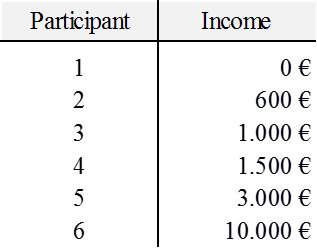
50% x 8.380.133.962 € / 8.562.901 = 489,33 € Let’s now consider a few hypothetical participants, with selected individual incomes. This way we can determine the UBI-AA financial effects, in these simulated conditions, for each one of them over the year 2019. The data now being filed amounts to our 4th factor: individual monthly income, which we will do simultaneously for six participants with different incomes, so that a broad and clear picture can be witnessed by applying this process. So:
4th – Individual monthly income (Ri):
Excluding, for now, taxation, an UBI-AA for all adults residing in Portugal over the year 2019, for participants with the above individual monthly incomes, would have the following financial impact:
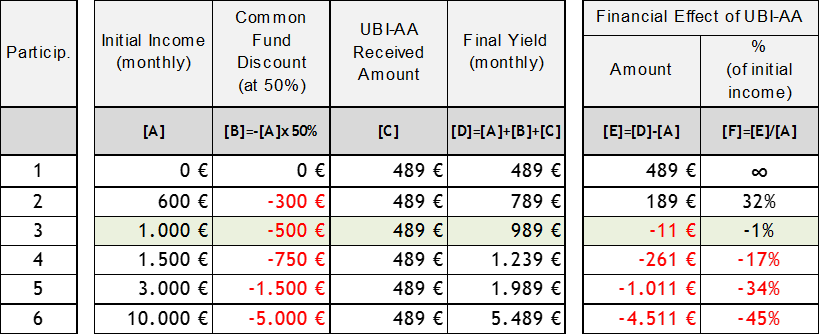
With each participant putting in the common fund half of his/her income and getting from it 489 € per month, those who had no income outside this process would benefit in absolute terms (infinitely, mathematically speaking, relative to their starting point). From that point onward, the benefits, still significant to lower level incomes, would be reduced as the latter increased, until reaching zero at around a 1000 € / month threshold (more precisely, 978 € / month). Whoever had an income over that limit, would lose money every month. He or she would lose just a little if the income was just above that tipping point and, gradually, would lose more the higher the income. Extremely high incomes would lose something close to 50%.
But this balance is still incomplete, since it ignores the fact that, without UBI-AA, people with income still have to, generally, pay the corresponding tax. In Portugal, that tax (IRS) does not apply to the lowest incomes but, as the latter rise, it applies with rising rates. That means, for the hypothetical participants in this simulation, that being subject to the IRS instead of UBI-AA would not affect the balance calculated above for those with the lowest incomes, but would affect all others, and do so to a greater extent the higher their income. In fact, participants with the highest income, if are those who transfer more to lower income participants in this process, are also those who benefit more from cancelling IRS. Finding the right balance between gains and losses over the personal context of the wealthy is key to an efficient, harmonious and sustainable process. In that sense, the UBI-AA fund contribution rate will generally reach its optimum a few percentage points above maximum enforced IRS rates.
IRS rates applying to each of our hypothetical participants, if they had not joined UBI-AA, compose the fifth and last of this calculation factor. This one is, among all factors, the most complex: potentially, this factor is not a given, but a large variety of possibilities, since IRS rates change with a wide range of personal life situations. In real life, each of our participants would reside in their own particular, probably unique, situation. One of them could be a freelancer, widower and living in Madeira Island; another could be a divorced public servant, with three children; another still could be a real estate investor, married and physically disabled, and so on. Out of UBI-AA, each one of them would be fitted into an IRS context, according to their situation, which would affect their respective tax rates. However, for this simulation purposes, it is convenient that each have the same personal situation, in order to highlight UBI-AA results exclusively as a function of income.
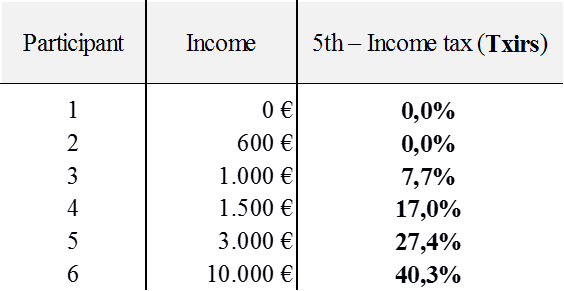
Let’s therefore suppose that, appart from their different income levels, all six of our UBI-AA participants are in the same exact personal situations relevant for IRS tax, which was considered as follows: they all receive an income from working for someone else, reside in Continental Portugal, are married to someone also getting an income and have a child.
This settles the fifth factor in our simulation. These IRS rates are called monthly tax bases, since they are monthly income collection rates, and in this case are listed as follows:
We can now finish the simulation. Universally applied to all adults living in Portugal in 2019, an UBI-AA built with a 50% fund contribution rate, would have the following immediate financial effects on these participants, with their respective incomes, calculated over the most conservative basis as explained above, monthly and annually:
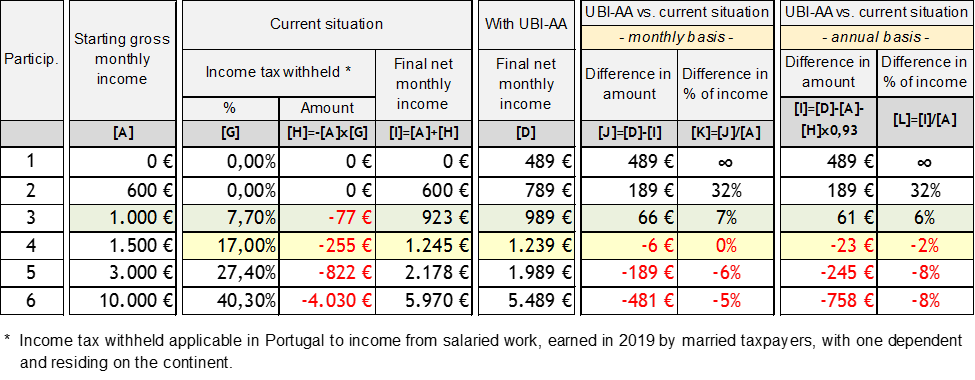
These final results show that UBI-AA would have guaranteed, to all adults living in Portugal, a monthly income of at least 489 €. This would be the increase in income for those who previously had none. As income from other sources increases, this gain progressively decreases, reaching zero for participants earning around 1500 € per month from other sources (1472 €/month for an annual calculation). Participants with marginally higher incomes, beyond that threshold, would suffer minor losses, which would rise with rising incomes. However, losses, as those suffered by richer participants, would not surpass 8% of their initial incomes.
Translated to English by André Coelho.